 UniRemoteLab
Dim a 230 V Lamp with ESP32: Zero-Cross Detection and Phase Control
You cannot dim a mains lamp with ordinary PWM. The ESP32 detects each zero crossing of the mains voltage, waits, then fires the TRIAC: the shorter the wait, the brighter the lamp. In the lab only the supervisor runs this one, for safety.
⚠️ In the lab only the supervisor runs this experiment, for safety.
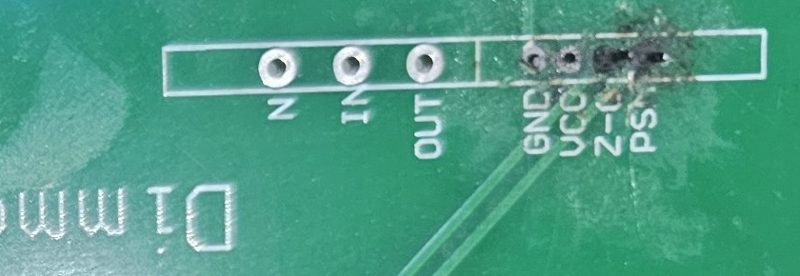
Wiring on the lab board
| Part | Pin |
|---|---|
| Zero-cross Z-C | GPIO33 |
| Trigger PSM | GPIO32 |
Full code
// Experiment 7: AC lamp dimming with the Dimmer (admin only) ⚠️ 220V
// Relays: K7 (PSM on GPIO32) and K8 (zero-cross on GPIO33)
// Phase-angle control: after each zero crossing we wait, then fire the triac with a short pulse
// Shorter delay = brighter. Type a percentage 0 to 100 in the send box
const int ZC = 33;
const int PSM = 32;
const int HALF_CYCLE_US = 10000;   // half a cycle on 50 Hz mains
volatile bool crossed = false;
volatile unsigned long crossings = 0;
int power = 0;                      // 0 = off ... 100 = full brightness

void IRAM_ATTR onZero() { crossed = true; crossings++; }

void setup() {
  Serial.begin(115200);
  pinMode(PSM, OUTPUT);
  digitalWrite(PSM, LOW);           // start with the lamp off
  pinMode(ZC, INPUT);
  attachInterrupt(digitalPinToInterrupt(ZC), onZero, RISING);
  Serial.println("Send power 0..100");
}

void loop() {
  static unsigned long lastReport = 0;
  if (Serial.available()) {
    power = constrain(Serial.parseInt(), 0, 100);
    while (Serial.available()) Serial.read();
    Serial.print("Power: "); Serial.println(power);
  }
  if (crossed) {
    crossed = false;
    if (power > 0) {
      int wait = map(power, 1, 100, 9000, 1000);   // from 9 ms (dim) to 1 ms (bright)
      delayMicroseconds(wait);
      digitalWrite(PSM, HIGH);
      delayMicroseconds(20);
      digitalWrite(PSM, LOW);
    }
  }
  if (millis() - lastReport > 2000) {               // every 2 s: number of zero crossings
    lastReport = millis();
    Serial.print("zero-crossings/s: ");
    Serial.println(crossings / 2);
    crossings = 0;
  }
}
The libraries are already installed in the lab.
How it works
- 50 Hz mains crosses zero 100 times a second, every 10 ms. The module raises Z-C at each crossing and attachInterrupt() catches it at once.
- After each crossing the code waits 1 to 9 ms depending on the power you set, then sends a short pulse on PSM that keeps the TRIAC on until the end of the half cycle.
- Every two seconds the code prints zero crossings per second, about 50 on European mains, so you know detection works.
Common mistakes and fixes
- ⚠️ Safety first
- Mains voltage can kill. Never touch the module or lamp while connected, and use a ready-made isolated module.
- The crossing counter is zero
- Z-C is not connected, or the module has no mains supply.
- The lamp flickers
- Many LED bulbs are not dimmable. Use one marked dimmable, or an incandescent bulb.
 Traffic light
 Switch and LED
 DHT11 with OLED